
Madison County NC Criminal Records Overview
Madison County criminal records are filed and maintained at the courthouse in Marshall, North Carolina. The Clerk of Superior Court manages all criminal case documents for Madison County courts. Located in the mountain region of western North Carolina, Madison County processes criminal cases through both Superior and District Courts in Marshall. The sheriff's office on Medical Park Drive and the Register of Deeds on Main Street also keep records that may relate to criminal matters. This guide covers how to find and obtain criminal records in Madison County.
Madison County Clerk of Court Criminal Records
The Clerk of Superior Court in Madison County handles all criminal case records. Criminal case files maintained by the clerk include indictments, warrants, motions, orders, plea agreements, and judgments. Superior Court hears felony cases in Madison County while District Court processes misdemeanors and infractions. Both courts contribute to the criminal record archive maintained at the courthouse in Marshall.
Under N.C.G.S. 132-1, criminal records in Madison County are classified as public records. This means any person may request to view criminal case files. You do not need to be a party to the case or provide justification for your request. The clerk's office will search for records by defendant name or by case number if you have one available.
The North Carolina Judicial Branch provides courthouse details for Madison County.
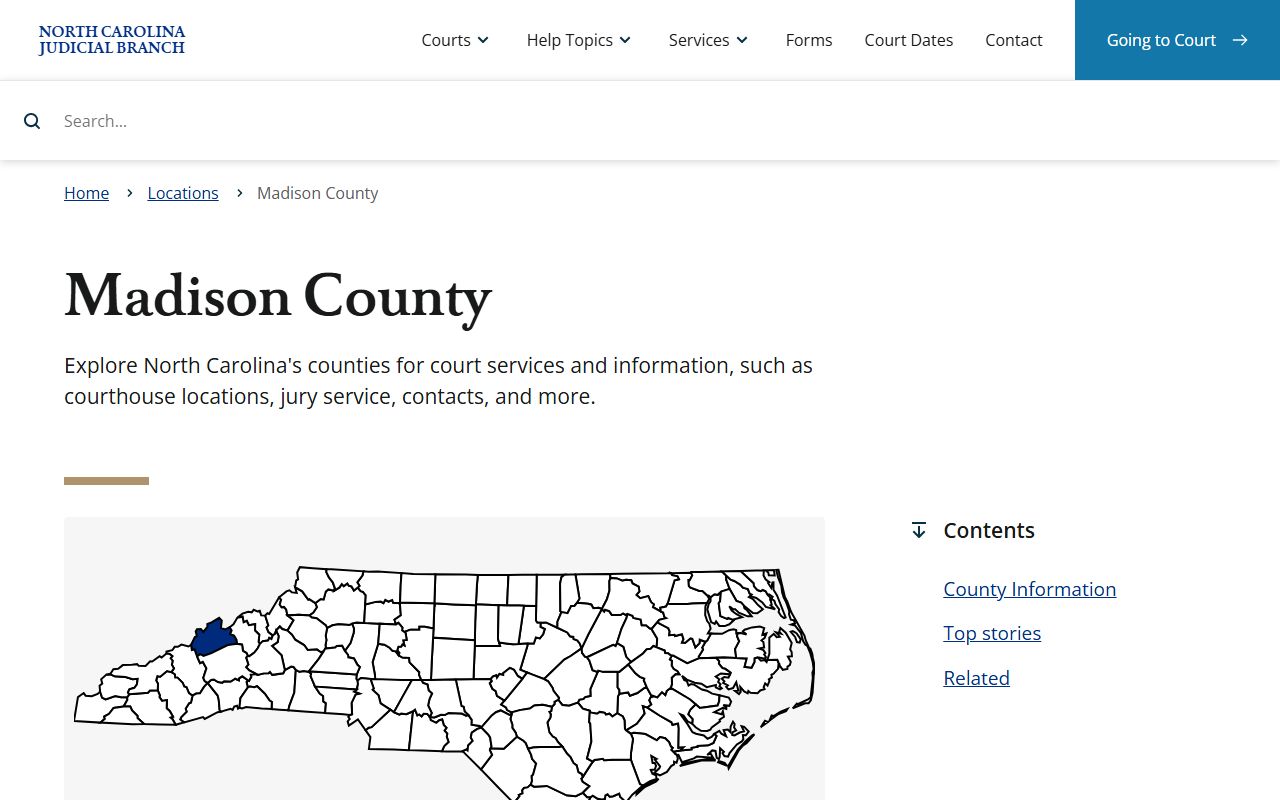
Go to nccourts.gov/locations/madison-county for information about the Madison County courthouse.
Madison County is one of the smaller counties in North Carolina by population. The lower volume of criminal cases compared to urban counties means that the clerk's staff can often retrieve records quickly. If you visit the courthouse in Marshall, expect a straightforward process. Bring the full legal name of the person whose criminal records you are seeking. A date of birth is also helpful for narrowing results in Madison County.
| Court |
Madison County Clerk of Superior Court Marshall, NC 28753 |
|---|---|
| Hours | Monday through Friday, 8:00 AM to 5:00 PM |
| Website | nccourts.gov/locations/madison-county |
Madison County Sheriff Arrest Records
The Madison County Sheriff's Office is located at 348 Medical Park Drive in Marshall, NC 28753. The phone number is (828) 649-2721. The sheriff maintains arrest records for all individuals taken into custody within Madison County. Each arrest creates a booking record that documents the person's identity, the charges, the arresting officer, and the bond amount set.
Arrest records held by the Madison County Sheriff serve a different purpose than criminal records at the courthouse. An arrest record confirms that law enforcement detained a person on specific charges. The criminal record at the courthouse tracks what happens after that point. Charges may be modified, combined, or dropped entirely before a final outcome is reached. For a thorough review of someone's criminal history in Madison County, it is wise to consult both the sheriff's office and the clerk of court.
Portions of the sheriff's records may be withheld during active investigations, as permitted by N.C.G.S. 132-1.4. Once a case is resolved, the full arrest record is typically available to the public in Madison County.
Other Sources for Criminal Records in Madison County
The Madison County Register of Deeds at 1 Main Street in Marshall can be contacted at (828) 649-3131. Liens and judgments resulting from criminal cases are sometimes recorded with this office. Criminal restitution orders, for example, may appear in property records when a court in Madison County requires a defendant to make financial payments as part of a sentence.
The NC State Bureau of Investigation provides statewide criminal history checks that go beyond Madison County. The SBI uses fingerprints to search arrest and conviction records from all counties in North Carolina. This is the most thorough way to verify whether a person has criminal records outside of Madison County.
Under N.C.G.S. 15A-145.5, some criminal records in Madison County may qualify for expunction. Eligible cases include dismissed charges and certain first offenses. An expunged record is removed from public view and will not appear in standard searches. Expunction petitions are filed through the clerk's office in Marshall.
The NC Courts website offers general guidance on court record access. The NC eCourts system at portal-nc.tylertech.cloud is expanding electronic access to criminal records in Madison County and throughout the state.
Madison County Criminal Record Access Laws
North Carolina's Public Records Act ensures that criminal records in Madison County are open to public inspection. Government records belong to the people, and the Clerk of Superior Court must provide access upon request. You do not need to state a reason for viewing criminal case files at the Marshall courthouse. The law applies equally to residents and non-residents of Madison County.
Certain records are restricted from public access. Active criminal investigation files may be withheld to protect ongoing law enforcement work. Juvenile proceedings are confidential. Sealed and expunged records are also exempt from public disclosure. But adult criminal cases with a final disposition are available to the public in Madison County. The clerk's office processes record requests during regular business hours at the courthouse in Marshall.
Criminal records from Madison County contain the standard information found in any North Carolina court file. Charges, court proceedings, plea agreements, and final dispositions are all documented. Sentencing records for convictions show penalties including incarceration, probation, fines, and community service. These records remain on file permanently at the Madison County courthouse unless expunged. The NC courts records page provides additional guidance on understanding criminal case information from Madison County and other jurisdictions.
Nearby Counties
An offense that occurred near the Madison County line may result in criminal records being filed in a neighboring jurisdiction.