
Union County Criminal Records and Court Case Access
Union County criminal records are maintained by the Clerk of Superior Court at 400 North Main Street in Monroe, North Carolina. As part of Judicial District 30, Union County processes a significant volume of criminal cases each year. The clerk's office manages all court filings for felony and misdemeanor charges heard within the county. The public can access criminal records, arrest records, and case disposition information through the courthouse and online tools. This guide details how to obtain criminal records from Union County offices.
Union County Criminal Records at the Clerk of Court
The Clerk of Superior Court at 400 North Main Street in Monroe, NC 28111, is the primary custodian of criminal records for Union County. The office phone number is (704) 698-3100. Staff at the clerk's office can help you locate criminal case files by defendant name or case number. The office handles both Superior Court felony cases and District Court misdemeanor matters.
Union County joined the eCourts system on October 14, 2024, as part of Track 6 of the statewide transition. This upgrade brought electronic filing capabilities to the county, allowing attorneys and the public to interact with criminal case records through digital platforms. The e-filing system has streamlined how new criminal cases are initiated and how records are stored in Union County.
The North Carolina Judicial Branch provides court details and available services for Union County.
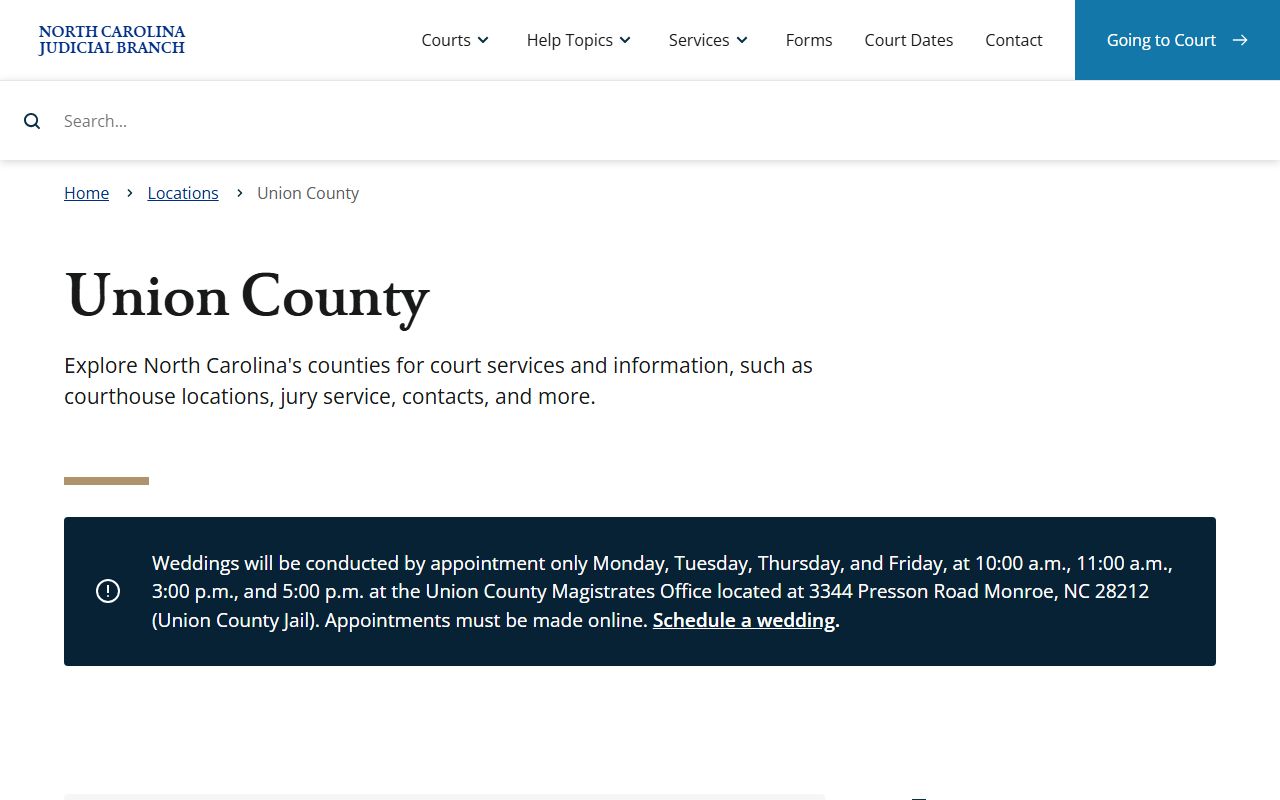
Go to nccourts.gov/locations/union-county for court schedules, contact information, and directions to the Union County courthouse in Monroe.
Criminal records available through the Union County clerk include charge documents, court orders, plea agreements, verdict records, and sentencing details. Each criminal case file contains a chronological history of every action taken from the initial filing through the final disposition. Certified copies of criminal records from Union County can be obtained for a fee set by the state.
Under N.C.G.S. 132-1, these criminal records are public. You have the right to view them without providing a reason. Certain investigative materials may be restricted under N.C.G.S. 132-1.4, but finalized court records in Union County are broadly accessible.
| Court |
Union County Clerk of Superior Court 400 North Main Street Monroe, NC 28111 Phone: (704) 698-3100 |
|---|---|
| Hours | Monday through Friday, 8:00 AM to 5:00 PM |
| Website | nccourts.gov/locations/union-county |
Union County Sheriff Arrest and Booking Records
The Union County Sheriff's Office at 3344 Presson Road in Monroe maintains arrest and booking records for the county. The office can be reached at (704) 283-3789. Every person arrested in Union County has a booking record created by the sheriff that includes the individual's name, charges, date of arrest, and bond information.
Arrest records in Union County are separate from the criminal case files at the courthouse. An arrest record shows that law enforcement detained someone on specific charges. It does not show how the case was resolved in court. Charges may later be amended, dismissed, or result in an acquittal. For a complete understanding of any criminal matter in Union County, you should consult both the sheriff's arrest records and the clerk's court records.
North Carolina's public records statutes give the public access to arrest records. However, the sheriff may hold back records related to ongoing criminal investigations as permitted by N.C.G.S. 132-1.4. Once a Union County case reaches its conclusion, all associated records become available.
How to Search Criminal Records in Union County
There are several approaches for searching criminal records in Union County. In-person visits to the courthouse at 400 North Main Street in Monroe allow you to review full case files and obtain certified copies the same day. Phone inquiries to (704) 698-3100 can help you confirm whether a specific record exists before traveling to the courthouse.
Online access to Union County criminal records is expanding through the eCourts system. Since the county joined the platform in October 2024, electronic filing and case search tools have become available. The state portal provides a way to look up criminal cases by defendant name or case number from any location with internet access.
Criminal case files in Union County include several document types. Charge records identify the offenses alleged against the defendant. Indictment records show formal charges brought by a grand jury. Plea records document any agreements between the prosecution and defense. Disposition records reveal the outcome of each charge. Sentencing records detail penalties imposed by the court, such as fines, probation, or incarceration. All of these form the complete criminal record for a Union County case.
Criminal History Searches Beyond Union County
A Union County criminal records search only covers cases filed within this jurisdiction. For a statewide criminal history check, the North Carolina State Bureau of Investigation conducts fingerprint-based background searches that cover all 100 North Carolina counties. This broader search captures criminal records that would not appear in a Union County-only inquiry.
The NC Courts help page explains how court records are managed across the state system. Since Union County has transitioned to eCourts, its criminal records are increasingly available through the eCourts portal alongside records from other participating counties.
Some Union County criminal records may qualify for expunction under N.C.G.S. 15A-145.5. Eligible records include dismissed charges, acquittals, and certain first-time offenses after a waiting period. Expunged records are sealed from public view and will not appear in standard criminal record searches of Union County. The Clerk of Superior Court in Monroe handles expunction petitions and can provide the required state forms.
Nearby Counties
If the subject of your search has connections to areas near Union County, criminal records may have been filed in one of these neighboring jurisdictions.